


A respectful look at the model that built most independent shops, the part of it that quietly stopped working around 2018, and the minimum a referral-only shop adds to stop losing the customers it already earned.
A shop owner sits at his desk on a slow Thursday afternoon. He has run the place for nineteen years. He has never spent a dollar on marketing. Not a postcard, not a Facebook ad, not a vendor pitch he did not hang up on inside two minutes. The bay outside is full most weeks. The work is good. The customers are loyal. He has a stack of business cards at the counter that go out the door faster than he can reorder them. When somebody asks how he gets his customers, his answer is the same answer it has been since 2006. Word of mouth. That is the whole engine.
He is not wrong. Word of mouth built his shop and it is still building it. He is also not seeing something. A driver in his city, last Tuesday afternoon, asked her neighbor where to take her Tahoe. Her neighbor gave her his shop's name. She pulled out her phone in her driveway, typed his shop's name into Google, looked at the search result for about twenty seconds, and called a different shop instead. He never saw her. He never heard about her. She is not on a report anywhere. She is just gone, and the next three Tahoes she will own over the next fifteen years will go somewhere else now too. That is the leak nobody is going to send him a notification about.
This article is not going to tell him he is wrong about word of mouth. He is not wrong. It is going to show him what a single Google search by a referred customer actually does to the funnel in 2026, why the model worked cleanly for thirty years and started leaking around the time everyone got a smartphone, and the smallest, cheapest, least-annoying set of moves a referral-only shop can add to plug the leak without giving up the model that built the place.
What Word of Mouth Actually Was, and What Changed

For most of the history of independent auto repair, word of mouth was a closed loop. A neighbor recommended your shop to another neighbor. The other neighbor wrote down the name on a piece of paper, kept it on the fridge or in the glove box, and called the number when something broke. The referral arrived at your phone with full trust intact, transferred directly from one human to another. The conversion from "I heard about this shop" to "I called this shop" was almost automatic. There was no third party in the middle.
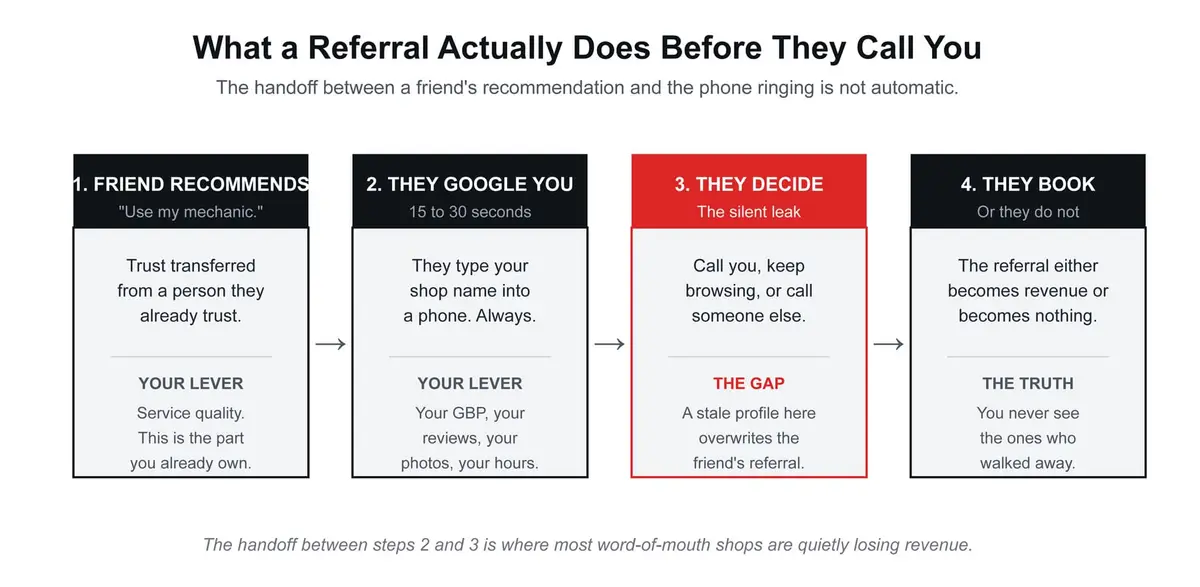
That loop quietly broke. Not all at once. Not because anyone tried to break it. The smartphone broke it. Specifically, the moment a critical mass of drivers started reflexively pulling out a phone to Google the name of any business someone mentioned to them, before they called. Industry research from BrightLocal and others has been tracking this shift for over a decade. The most recent local consumer surveys put the share of people who search for a recommended business before contacting them at well over 80 percent. For service categories with any meaningful price tag, where the prospect has time to look, the number is higher.
The referral did not disappear. The handshake between the referral and the phone call got handed off to Google. That handoff is where the leak lives.
This is not a moral judgment on phones. It is a description of how a 2026 prospect actually behaves. She gets the recommendation. She trusts it. She still searches. Because the search is fast, the search is what her phone is built for, and the search lets her quietly verify the friend's recommendation against what the rest of the world says about the business. If what the rest of the world says is "this shop has 17 reviews, the most recent one is from 2021, the photos are stock images, and the hours have not been updated since the pandemic," her brain interprets that as a soft warning. Not a hard no. A soft "maybe somewhere else." She calls the shop next door whose listing looked more recent.
The first read: word of mouth still produces the referral. The referral now has to survive a 20-second phone search before it becomes a customer. What the search shows is the variable nobody used to have to worry about.
Why the Shop Owner Does Not See the Leak
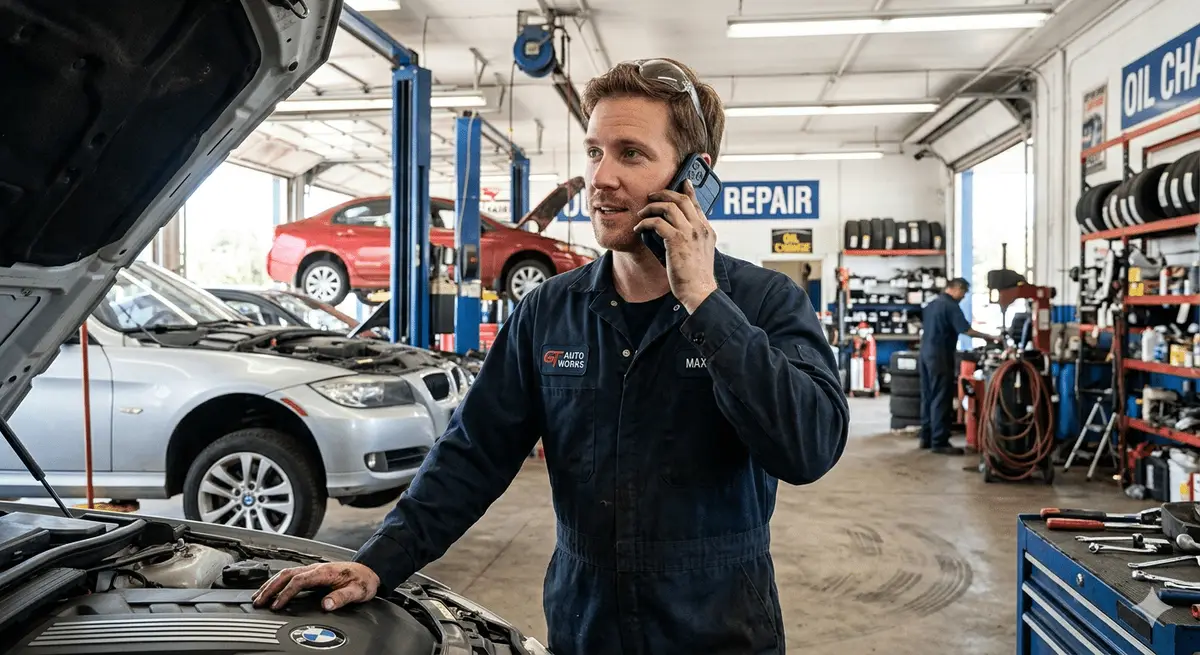
The leak is invisible by design. The customers who do call you still came from word of mouth, so the model looks like it is working. The customers who got the recommendation, searched, and went elsewhere never identified themselves to you. They are not in your CRM. They are not on a missed-call log. They never existed from your perspective. The only person who knows they happened is the person who looked at the search result, and she is not going to call you to explain why she did not call you.
This is the same reason a slow leak in a coolant system can run for months before the owner notices. There is no warning light for the customer you almost had. The dashboard reads normal because the dashboard cannot see the thing that is missing.
The shops that have run on referrals for decades are also the most likely to miss this, because their internal narrative is intact. "We have always run on word of mouth and it has always worked." Both halves of that sentence are true. The part the sentence does not contain is "and the percentage of referrals that quietly bounce at the search step has gone from roughly zero in 2005 to a meaningful chunk in 2026, and we cannot see it." Nobody is lying. The data the owner has access to just does not contain the missing customers.
The Three Things That Actually Get Looked at in That 20-Second Search
When a referred prospect types a shop name into Google, three things load in front of her face within a couple of seconds, and the decision happens against those three things. Not against the friend's recommendation. The recommendation got her to the search. The search is now a separate moment.

1. The Google Business Profile panel on the right side of the screen
The most visually dominant element on the search result is the GBP. Photo of the shop, star rating, review count, hours, phone number, address, services list, recent reviews scrolling underneath. This is the digital storefront. It is the modern equivalent of the prospect driving past your bay before booking, except now every prospect drives past, and the storefront has to be open and clean every time.
A shop with a complete GBP, real recent photos, a steady stream of reviews from the last few months, and accurate hours reads as alive. A shop with a half-finished GBP, three reviews from 2019, no photos other than the Google street view of the building, and "hours not confirmed" reads as a question mark. Same shop. Different storefront.
2. The star rating and the most recent review snippet
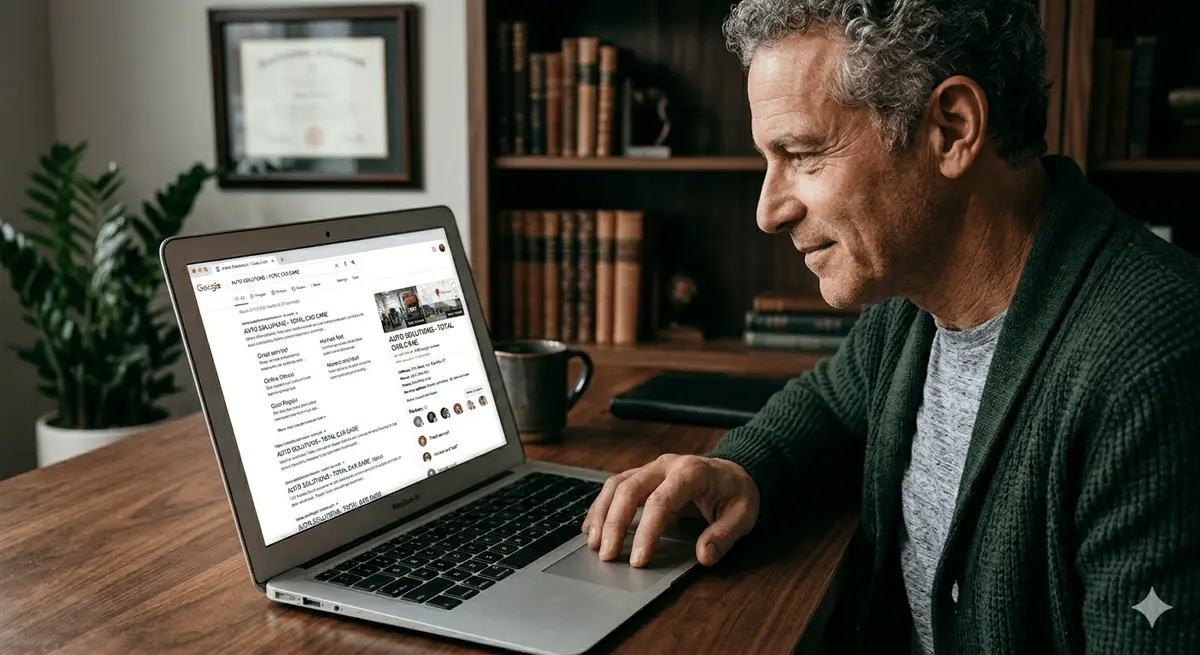
The eye goes to the star rating first and then to the snippet of the most recent review the GBP chooses to display. The rating is a fast filter. Anything 4.5 or above is fine. Anything 4.2 to 4.5 is a soft pause. Below 4.0 is a hard no for most prospects in a service category they care about.
The recent review snippet does work the star rating cannot. A glowing 4.9-star average with the most recent review being a one-star rant from six months ago that nobody from the shop replied to still costs you the call. The prospect reads the rant, notices the silence, and decides she does not want to find out which kind of experience she is going to have.
3. Everything else, in a distant third
The website. The Facebook page. Yelp. Random directory listings. These all matter much less than the first two for the referral search specifically. The prospect rarely clicks past the GBP. She already had the recommendation. She is not doing a deep dive. She is doing a 20-second sanity check.
What this means in practice. A referral-only shop that adds nothing else can get most of the leak fixed by handling steps 1 and 2 well. The work below this section is the bare minimum that does it.
The Minimum a Word-of-Mouth Shop Adds, Built in Order
This is not a pitch to become a marketing-heavy shop. It is a description of the smallest, cheapest set of moves a referral-driven owner can make to stop losing the prospects he is already earning through the work itself. Almost none of it costs money. All of it requires attention and consistency, which are the resources a word-of-mouth shop already has more of than a marketing-heavy shop does.
1. Claim and complete the Google Business Profile
Free. Takes a couple of hours. It is the chassis of the entire digital handshake. The non-negotiable basics:
- Primary category set correctly. For most independent shops, that is "Auto Repair Shop." Not "Mechanic." Not "Car Service." The wrong primary category is the single most common reason a real shop ranks below a clearly weaker one nearby.
- Every relevant secondary category added. Brake Shop. Oil Change Service. Smog Inspection Station. Transmission Shop. Tire Shop if you do tires. These help you show up in searches for services beyond your primary.
- Hours accurate, including holiday hours. Wrong hours hurt twice. They miss the prospect who wanted to come in, and they lower Google's confidence in the rest of your data.
- A dozen real phone photos of the actual shop. Outside. Inside. The waiting area. The bay. The team. Not stock images. Phone photos beat stock images every time.
- The full services list populated with the actual services you offer, named the way customers actually search for them. "Brake pad replacement," not "brakes."
- A real description of the shop in your own words, mentioning the city and the work you do.
- This is the foundation. Every other layer compounds on top of it. A referral who searches your name will see this panel within a second of typing. Make it real. That is the entire instruction.
2. Ask every happy customer for a Google review

Reviews are the heaviest single trust signal in local search. They are also the thing the referred prospect glances at before she dials. A shop with 22 reviews, no matter how good the work, is at a meaningful disadvantage to the shop down the street with 180, even if your average rating is higher. Volume matters. Recency matters more than most owners realize. A shop with 200 reviews where the most recent one is from 2022 looks dormant. A shop with 60 reviews where 8 of them are from the last 90 days looks alive.
The minimum system, for a referral-only shop that does not want to add complexity:
- At checkout, when the customer is happiest and the experience is fresh, the service writer hands them the receipt and asks the question. "Would you be willing to leave us a quick Google review when you get a minute? It is the one thing that really helps a small shop like us." That is the script. No discount offered. No pressure. Just the ask.
- A QR code on the receipt and inside each bay that links directly to the Google review page. Most modern receipt printers can print one. If yours cannot, print a small card.
- A short SMS sent within a couple of hours of the work being completed, with the review link. This requires nothing more than your phone or a basic texting tool. Even sending it manually for the first month proves the pattern.
- That is it. Ten happy customers asked per week, three or four reviews collected, and inside a year the shop has added 150 reviews to whatever it started with. That alone closes most of the search-step leak.
3. Respond to every review, good or bad, within 24 hours
This is the cheapest, highest-leverage move in the entire list, and almost nobody does it consistently. A response to a five-star review is one sentence. "Thanks Sarah, glad we got the Camry back on the road quickly." A response to a one-star review is two or three sentences, written in the voice of a real person, acknowledging the customer's experience and offering to make it right offline. No defensiveness. No blame.
The reason this matters has very little to do with the customer who left the review. The customer who left the review is already gone or already loyal. The reason this matters is that the referred prospect doing her 20-second sanity check next Tuesday is reading the response, not just the review. A shop that responds to every review reads as a shop that pays attention. A shop that responds to nothing reads as a shop that has stopped showing up. The math is unfair in both directions.
The time cost is roughly five minutes a day, or twenty-five minutes a week if you batch it. There is no cheaper trust signal in the entire local search ecosystem.
4. A simple Auto Repair website that loads cleanly on a phone
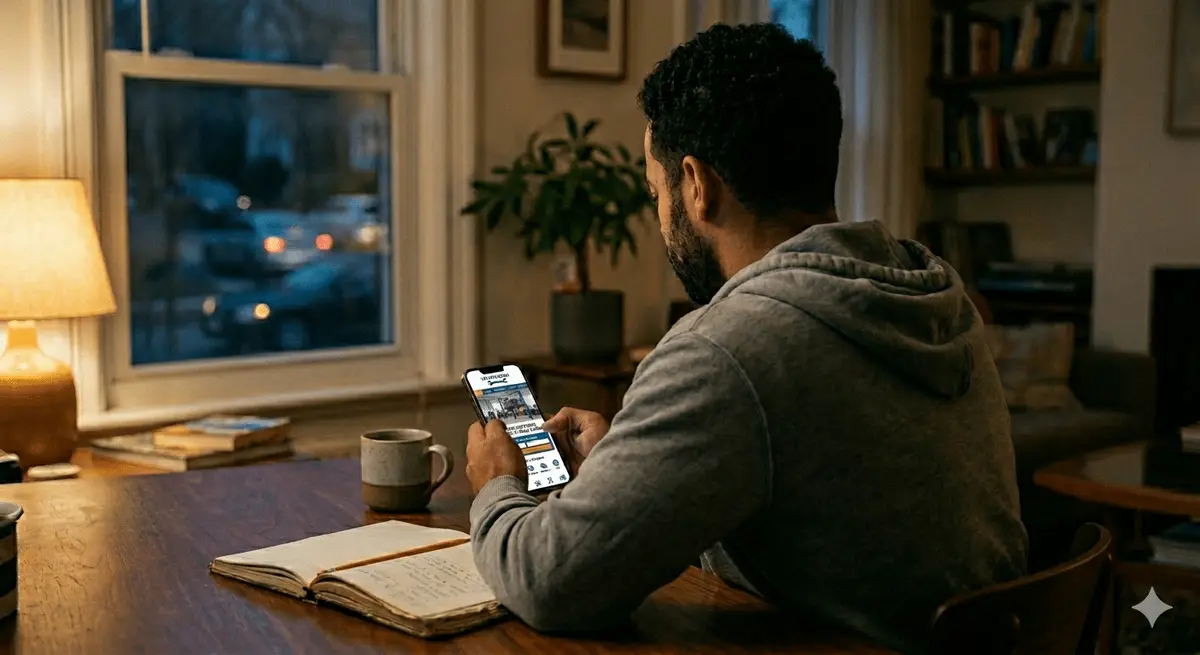
The prospect doing the 20-second sanity check rarely clicks through to the website. But she does sometimes, and when she does, what the site looks like matters less than whether it works. The minimum:
- One page. The shop name, the address, the phone number, the hours, a short list of the services you offer, a few real photos, an embedded Google map. That is the entire site.
- Loads in under three seconds on a phone over LTE. If it takes longer, that is a foundation issue. A clean one-page site on a basic host loads in under a second.
- The phone number is a click-to-call link in the header, visible the moment the page renders. Not buried in a contact form.
- You do not need a $4,000 site to fix the referral leak. You need a site that exists, loads, and shows the same phone number Google has. A free or near-free single-page builder is enough for layer four. The deeper website work is a different conversation for a different stage of the shop's life.
5. A light social presence, mostly so the profile is not abandoned
Last and lightest. Most referral-driven shops do not need a real social media engine. They do benefit from a Facebook page (where their actual customer demographic still lives) that is not visibly abandoned, with one or two posts a month. A photo of a finished repair. A heads-up about a holiday schedule. A new tech joining the team. That is the entire content brief.
The reason this is layer five and not layer one is that the prospect doing the sanity check rarely checks Facebook unless the GBP and reviews are missing. If you fix layers one through three, layer five becomes background hygiene. If you skip layer one and try to start with social, you are pouring fuel into an engine that is not connected to anything.
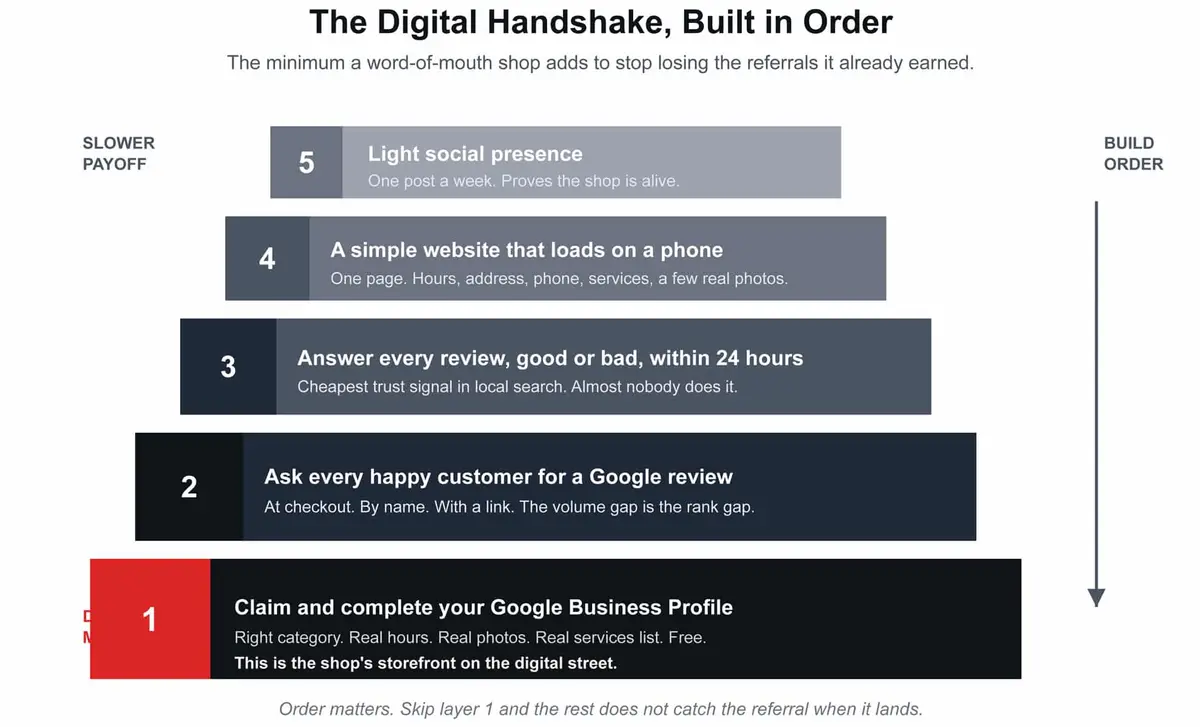
The order is not optional. GBP first. Reviews second. Responses third. Website fourth. Social fifth. Skip the order and the work you do at layer five never catches the referral the friend already sent.
The Math, the Way a Shop Owner Runs It

Now run the numbers in your own units, for your own shop, before anyone tries to sell you anything.
Say your shop currently gets about 25 word-of-mouth referrals a month from existing customers, neighbors, and the friend-of-a-friend network you have built over the years. Say your average repair order is $475 with a 50 percent gross margin, so $237 in gross profit per RO.
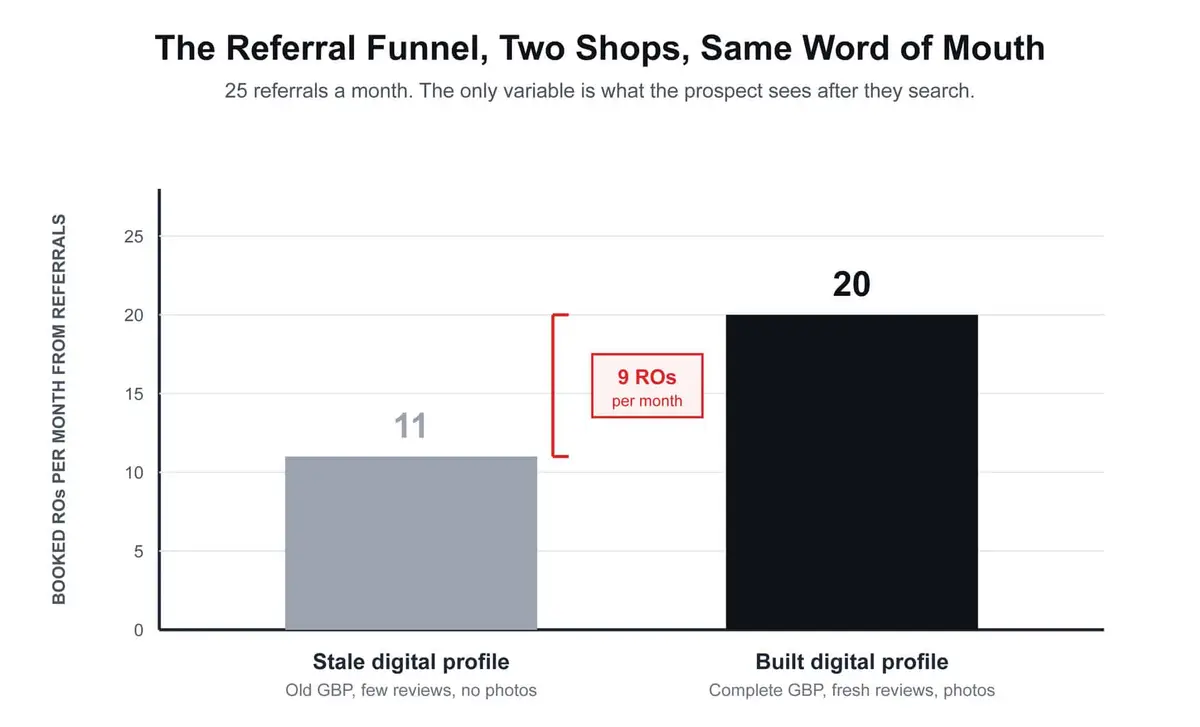
Industry data on referred-prospect search behavior, drawn from BrightLocal and SearchLab local consumer research over the last few years, suggests that even strong word-of-mouth shops with weak digital profiles convert somewhere around 40 to 50 percent of their referred prospects into booked customers in the modern environment. The rest bounce at the search step. Shops with a complete, recent, well-reviewed digital profile convert 75 to 85 percent of the same referrals. The recommendation is the same in both cases. The variable is what the prospect sees in those 20 seconds.
Take the conservative end of both ranges. Stale profile shop converts 11 of 25 referrals into booked customers. Built profile shop converts 20 of 25. The gap is 9 booked customers per month, with no change in the work, no change in the techs, no change in the front desk, no change in the referral source. Same neighbors saying the same things to the same people. Different storefront.
At 9 incremental bookings per month, at $237 gross profit per RO, that is roughly $2,130 in monthly gross profit, or $25,560 a year, that the stale-profile version of the shop is quietly losing to whichever competitor's listing looked more current. The work to close that gap, at the layers above, costs roughly two afternoons of setup, plus a few minutes a day of review responses and a few seconds at every checkout. No paid ads. No marketing agency. No platform subscriptions.
That is not the math for adding marketing to a word-of-mouth shop. That is the math for protecting the word of mouth a shop already earned. The recommendation is still doing all the work. The digital handshake is what keeps the recommendation from cooling off in the 20 seconds between the referral and the call.
The compounding part is the point. Every review you collect, every photo you post, every response you write is still working for you in month 18 when a new prospect runs the same 20-second search. Unlike paid ads, the work does not disappear when you stop spending. It is equity, and it compounds quietly in the background while the referrals keep coming.
What to Do This Week, in Order
If you can give this one afternoon, do it in this order before you write a check to anyone for anything:
1. Open Google on your phone and type your shop name plus your city. Look at the result like a stranger would. Note the star rating. Note the review count. Note when the most recent review was posted. Note whether the photos are real or stock. Note whether the hours look current. That is what a referred prospect sees.
2. If you have not claimed your Google Business Profile, claim it. It is free. It takes a phone call from Google or a postcard. Set the primary category to "Auto Repair Shop." Add every relevant secondary category. Add real hours. Add a dozen real phone photos this week.
3. Pick one customer from yesterday's invoices who left happy. Text them tonight. "Hey Sarah, thanks again for letting us handle the Camry. If you have a minute this week, a Google review would mean a lot to a small shop like ours. [link]." See what happens. Do it again tomorrow with a different customer. The system is the habit, not the tool.
4. Open your reviews tab. Find the most recent review you never responded to. Write a one-sentence response. If it is a one-star review you have been avoiding, write three sentences acknowledging the experience and offering to talk offline. Then do the next one. Catch up to the present and stay there.
5. Type your shop's website address into your phone. Time how long it takes to fully load over a phone connection. If it is over three seconds, or if you do not have a website at all, that is the next thing to fix. A single clean page is enough.
That is the diagnostic. None of it requires giving up the word-of-mouth model that built the shop. All of it makes that model work in a market where every referral now travels through a phone search before it becomes a customer.
The shops that ran on referrals for thirty years are not wrong about the model. They are right about the model and slightly behind on the handoff the model now has to make. The shops that protect the handoff keep compounding the work they have already done. The shops that do not, slowly bleed referrals they will never see leave.
If you want a faster read on what your shop actually looks like to a referred prospect searching your name on a phone (the GBP, the reviews, the photos, the response patterns, and the parts of the digital handshake that are quietly costing the call), the GBP Leak Report runs the diagnostic and shows you, line by line, what the search step is doing to your word-of-mouth funnel. No admin access required. No commitment. You get a written read on what the rest of the internet sees when your name comes up, and what one or two changes would close the biggest gap first.