

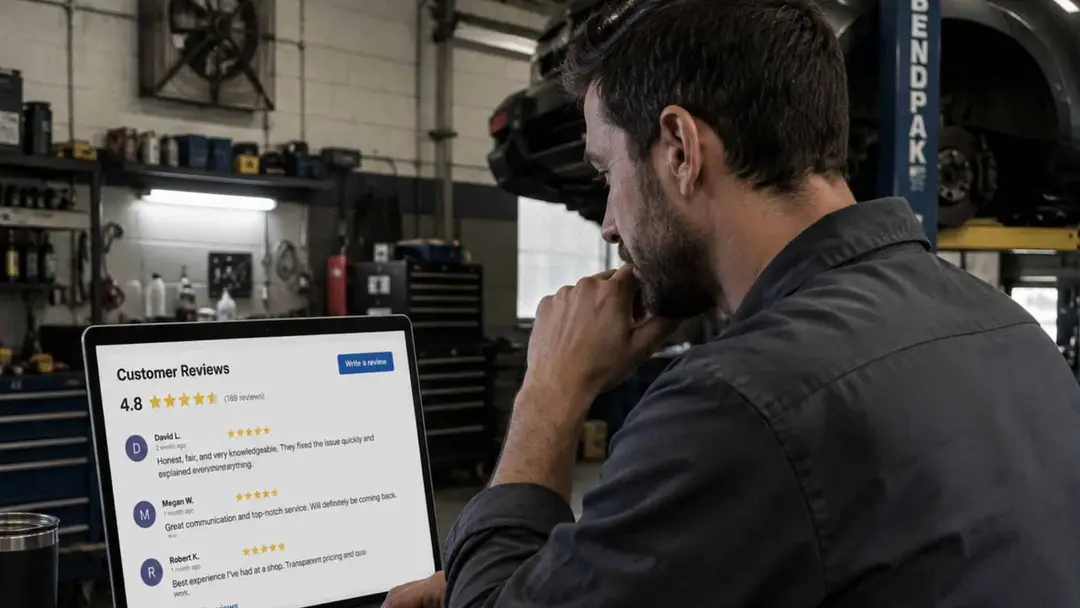
A practitioner's playbook for handling the one-star review the way the next thirty prospects will actually read it.
A shop owner opens his phone at 6:42 on a Wednesday morning. There it is. One star. Three paragraphs. A customer he half-remembers, claiming the alignment is worse than when she dropped the car off, claiming the writer was rude, claiming she will tell every neighbor on her block. He knows two of those three things are not true. He knows the alignment was within spec because he watched the tech pull it up on the rack himself. He starts typing a response that begins "Actually, ma'am..." His thumb hovers over post.
That is the moment the review either becomes a problem he answers in five sentences, or a problem that sits on his Google Business Profile for the next three years, deterring strangers he will never get to argue with. The reviewer is one person. The audience is everyone reading his profile from now until the review rolls off the visible page, which on an auto repair shop with normal volume can be a year or more.
Here is the part most owners miss when they hit post on the "Actually, ma'am" response. The reviewer is already gone. She left the review because she was done. The five sentences you write underneath are not for her. They are for the next thirty prospects who will land on your profile, scroll the recent reviews, and read your response the way a hiring manager reads a candidate's reaction to a hard interview question. The way you handle the worst review on your page is, for a meaningful slice of your future customers, the single most informative thing they will ever read about your shop.
So let's stop reacting and start running the protocol. We are going to walk the diagnostic the same way we would walk a misfire. What Google reads when an owner responds. The five-part anatomy of a response that protects the chassis instead of cracking it. The exact mistakes that turn a recoverable one-star into a permanent leak. And the math on what one unanswered negative review costs a shop over a year.
What a Negative Review Actually Is, and Who You Are Writing the Reply For
A negative review is not a customer complaint. A customer complaint is what you fielded in person three weeks ago when she drove back in. A negative review is a public artifact on a page Google will keep showing to drivers searching for shops in your service area for as long as the review stays visible.
That changes everything about the response. The reply is not a service ticket. It is marketing copy, written in a high-stakes moment, judged by strangers who have no context except what is on the screen. Industry research from Autoshop Solutions and Kukui on auto repair reputation puts the practical impact in stark terms. One unanswered negative review can deter on the order of thirty prospects from calling. A thoughtful, calm reply recovers most of that audience by signaling that a real human owns the shop, reads what is said about it, and handles problems without losing composure.
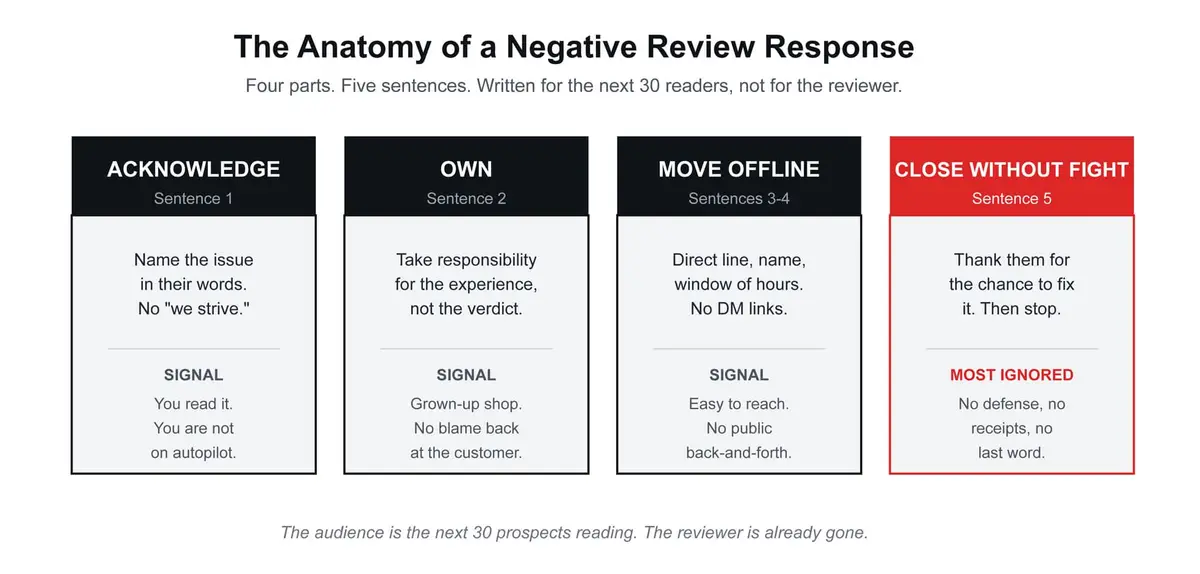
The math behind that recovery is the entire reason to take the response seriously. Five sentences, written in twenty minutes, written for an audience that is reading you while you reply, is one of the highest-leverage moves in your entire local marketing pipeline. It costs nothing. It compounds. And almost no shop does it consistently.
The first read: the reviewer is the trigger. The next thirty prospects are the audience. Write to the audience, not the trigger, and the response writes itself.
The Five-Sentence Anatomy of a Response That Works
Every effective response to a negative review on an auto repair Google Business Profile fits inside five sentences. Longer than that and you sound defensive. Shorter than that and you sound dismissive. The structure is fixed.
Here is what that reads like on the page, written for the alignment review at the top of the article:
Sarah, thank you for the feedback and I am sorry the alignment did not feel right after the visit. I want to take a look at it myself and make this right. Please call me direct at (555) 123-4567, ask for Mike, and I will get you back on the rack at no charge to verify the spec. I am at the shop most weekdays from 7:30 to 5:00, or you can reach me through the front desk at the main number if I miss your call. Thanks for giving us a chance to fix it.
Five sentences. Specific name. Specific number. Specific time window. No mention of what the techs documented. No mention of the rude-writer claim. No "we strive for excellence." No "we are sorry you feel that way," which is the most weaponized non-apology in the language and reads as exactly that to anyone with a working ear.
The next thirty prospects who read that exchange do not need to know who was right about the alignment spec. They need to know that if something goes sideways at your shop, the owner shows up, gives them his number, and offers to put the car back on the rack. That is the entire signal. The signal is the marketing.
Why "we are sorry you feel that way" actively hurts you
Three words to never type in a response: feel, perceive, experience-as-if. They all carry the same subtext, which the reader picks up instantly. "We are sorry you *feel* the alignment was off." "We are sorry you *perceived* the writer as rude." Translation, to every reader: we think you are wrong, but we are pretending we are big enough to apologize for your wrongness. It is a non-apology dressed in customer service clothes. It deters more readers than the original one-star did.
Replace it with the actual issue. "I am sorry the alignment did not feel right." "I am sorry the front-desk interaction was not what you expected." Same length. Different mechanic. The reader feels a shop owner, not a corporate filter.
The Protocol, In Build Order
Most "respond fast" advice from generic reputation blogs misses what actually happens in a working shop. You read the review at 6:42 a.m. You are angry. You know the customer is wrong about two of three claims. You have a service writer who already left for the day and a tech who is not in until 8:00. You have eleven cars on the schedule and a parts delivery to manage by 9:00. The advice "respond within two hours" with no protocol around it is how shops end up posting the "Actually, ma'am" reply they cannot delete.
Here is the order to run it in instead. The protocol exists so that the heat of the moment never reaches the keyboard.
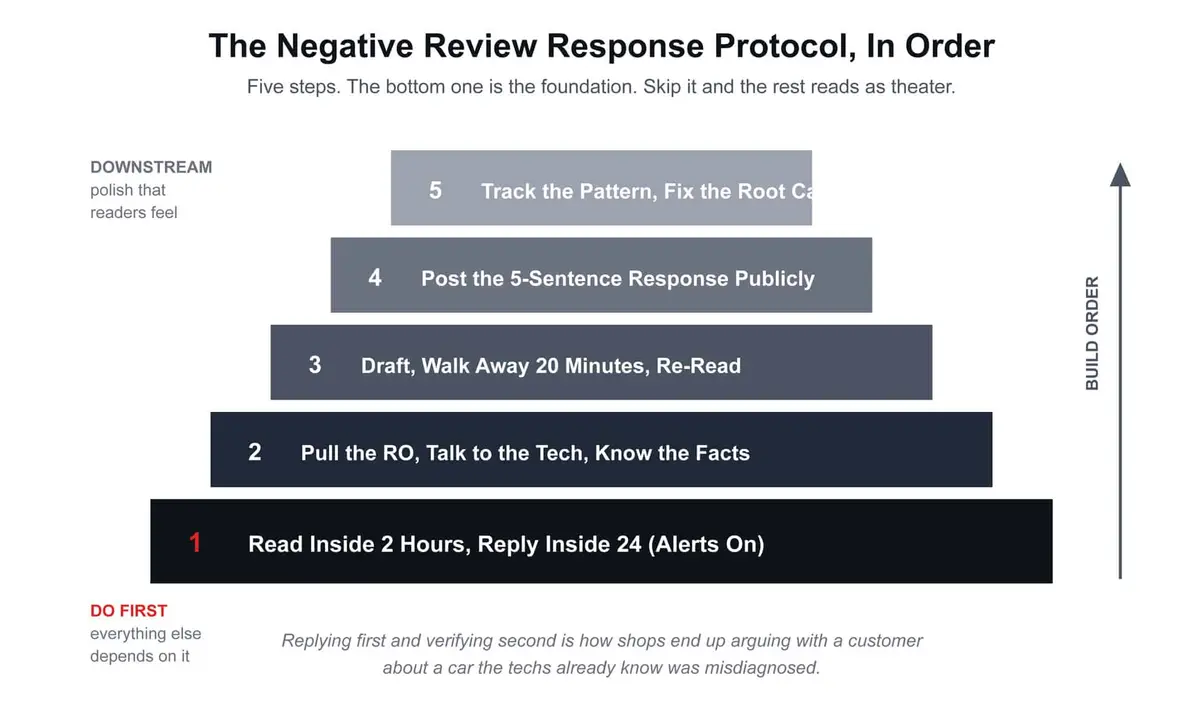
1. Read inside two hours. Reply inside twenty-four. Get alerts on.
You cannot run the protocol if you do not know the review exists. Step one is operational, not creative. Turn on Google Business Profile notifications, route them to a single email and SMS line that the owner or general manager checks throughout the day, and read every review inside two hours of it landing. Reply inside twenty-four. That window does two things at once. It signals attentiveness to the reader. And it gets the reply written while the facts are still fresh enough to verify.
The Kukui reputation playbook recommends responding publicly within two hours when possible. That is the aspiration. The floor is twenty-four. A review that sits unanswered for a week reads to a prospect as "this shop does not check their listing," which is almost worse than the negative review itself.
2. Pull the RO. Talk to the tech. Know the facts before you draft.

The single most common cause of a response that makes things worse is replying before checking the file. Before any draft gets written, pull the repair order, look at the notes, listen to the tech's version, and look at the call recording if there is one. Not to build a case for the public reply. To know whether the customer's complaint is accurate, partially accurate, or fully off the mark, because the reply is different in each case.
If the customer is right, your reply leans heavier on the apology and lighter on the offer. If the customer is partially right, your reply acknowledges the part that landed and offers the recheck on the part that did not. If the customer is fully wrong, the reply does not say so publicly. It still offers the recheck. The disagreement gets resolved on the phone, not on Google. The audience reading the exchange does not need to be the jury.
3. Draft. Walk away twenty minutes. Re-read it as the next prospect would.
This is the step that separates shops that hold their reputation from shops that crack it. Write the draft. Save it. Walk to the bay or step outside or pour a coffee. Twenty minutes. Come back and read it as if you were a prospect in your service area who landed on your profile for the first time today. If a single sentence reads as defensive, sarcastic, passive-aggressive, or self-justifying, cut it. If a single word reads as corporate filler ("strive," "value," "appreciate your business"), cut it.
The twenty minute cool-down is non-negotiable for any review the owner has a personal reaction to. Most one-star reviews qualify.
4. Post the response publicly. Use a real name. No links to DM.
Sign the response with a real first name. "Mike, owner" or "Sarah, general manager." Never "the management team." Never "Service Department." The reader is judging whether a human runs this shop. Anonymity tells them no.
Do not include a link to a contact form or a DM. The offline channel is the phone number. Customers who are still angry are not going to click a form. They will call if they want to, which is exactly the conversion you want, or they will not, which tells you the review was venting more than seeking resolution. Either way, you handled it the same correct way in public.
5. Track the pattern. The third one-star about the same issue is a process problem, not a customer problem.
A single negative review is a customer event. Three negative reviews about the same writer, the same service, or the same shift is a diagnostic on your shop. If two of the last six one-stars mention the same service writer being short with people, the issue is not the reviewers. The issue is the writer, or the writer's workload, or the writer's training, and no amount of polished response writing is going to fix what is broken inside the bay.
Keep a simple log. Date, reviewer name if shown, RO number if you can match it, theme of the complaint. Review it monthly. The pattern is the message. The response is the receipt.
The honest version: most shops respond once, vent in the response, and never look at the pattern. The shops that do look at the pattern fix the root cause inside one quarter and stop generating the kind of reviews that need this protocol in the first place.
What Not to Do, in Plain Terms

A few moves look like vigorous customer service and are not. They are torque applied in the wrong direction, and they break the chassis.
Do not argue the facts in public. Even when you are right. Especially when you are right. The audience cannot verify the facts. They can only see who blinked first into a public fight. The reader's read of "shop owner argued with a customer on Google" is the same regardless of who was correct on the merits.
Do not post the customer's personal information. Their RO number, their car make, their address, their phone, their full name if it is not already on the review. This is a violation of Google's review policies and in some states a privacy violation on top of it. The shop owner who posts "Sarah Thompson at 123 Oak Street, we have called you four times" lost the marketing battle the second they hit post, no matter how true the four-times claim is.
Do not flag a real negative review as fake hoping Google removes it. Google's filter knows the difference between a fake review and a real review that hurts. Flagging real ones wastes the one tool you actually need (flagging genuinely fake or policy-violating reviews) and signals nothing useful to anyone. The 180biz reputation guide and Identifix's reputation management research both make the same point: flag only what genuinely violates policy, otherwise spend the energy on the reply.
Do not respond from the front desk's phone in three minutes between cars. Hand the response writing to one person, owner or GM, who runs the protocol. The reply is marketing. It deserves the same care as the homepage headline.
Do not skip responses on the four-star "everything was fine but" reviews. Mild negatives need replies too. Three sentences. Thank them, name the one thing they flagged, mention how you will use the feedback. Skipping these because they are not five-star is how shops end up with thirty unanswered three-stars in a row, which reads to a prospect as worse than two answered one-stars.
Do not use an AI tool to write the response and post it untouched. Readers can spot the cadence in two seconds. Use AI to draft if you want. Always rewrite in your own voice before posting. The protection of your reputation is not a place to outsource the words.
The Math, the Way a Shop Owner Runs It
Here is where reputation work stops being vague and starts being a line on the P&L.
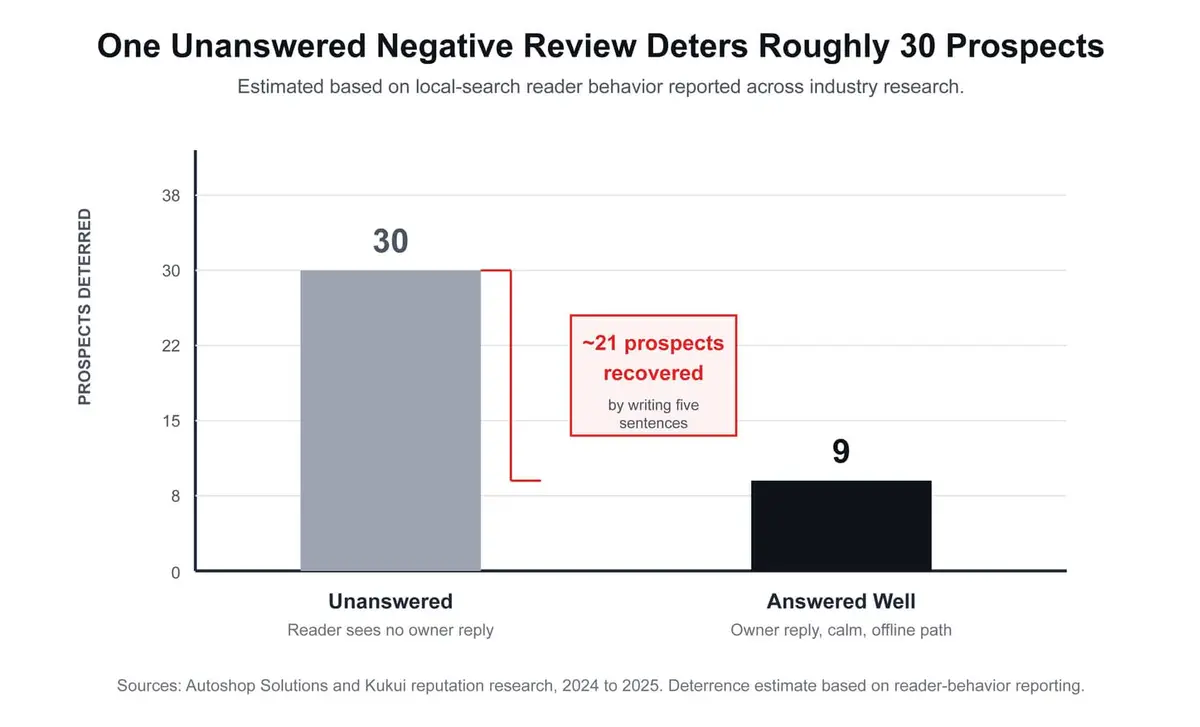
Start with the deterrence number. Industry reputation research, including the Autoshop Solutions and Kukui auto repair guides, has consistently described the impact of an unanswered negative review in the range of around thirty prospects deterred per review for a local service business with a meaningful local search footprint. Call it thirty for the math. A thoughtful response does not eliminate the deterrence. It cuts it meaningfully, because readers who see an owner reply calmly read the negative review through that lens. Call it nine remaining deterred, twenty-one recovered.
Now run the dollars. Say your shop's average repair order is $450 with a 50 percent gross margin, so $225 gross profit per RO. Of the twenty-one prospects you recover by writing five sentences instead of zero, assume only ten percent ever actually call (most local-pack readers do not call any specific shop on any specific visit). That is about two extra calls per unanswered-negative-recovered. At a 45 percent call-to-booking close rate, that is roughly one extra booked RO per negative review recovered. One RO at $225 gross profit. From five sentences. From one review.
Multiply that across a year. A shop with normal volume picks up somewhere between four and twelve negative reviews a year, depending on size and category. A negative-review response protocol that recovers one RO per review, conservatively, is producing $900 to $2,700 in incremental gross profit annually for what amounts to two hours of work a month spread across the year. That ignores the second-order effect, which is the larger one: the response shapes how every prospect reads your *positive* reviews too. A shop that responds visibly across the page reads as a shop that runs a tight operation. The whole listing converts at a higher rate, not just the one negative.
The compounding part again, because owners miss it the first time: the response you write today is still working for you in month twenty-four. The reader who landed on your profile last Wednesday and read your calm, specific, real-name reply to a one-star booked their oil change two months later. You will never know it was the reply that did it. The math still ran.
What to Do This Week, in Order
If you can give this one afternoon and one staff meeting, do it in this order:
1. Open your Google Business Profile and read every negative review from the last twelve months. Count how many have a response. The unresponded ones are your project for the next 90 minutes, in order from most recent to oldest.
2. Pull the RO for each negative without a response. Five minutes per review. Note the facts. If the file is gone, note that too and write the response accordingly.
3. Draft a five-sentence response for each one. Walk away twenty minutes between drafts and final post. Sign with a real name. Use a specific phone number.
4. Turn on Google Business Profile notifications to your phone and email today. Route them to the one person who will run the protocol from now on. Owner or GM. Not a rotating chair at the front desk.
5. Write your shop's standard five-sentence response template with placeholders for the customer name, the specific complaint, the owner name, the direct number, and the hours window. Save it where the responder can find it on a Saturday morning when the alert hits.
That is the diagnostic. None of it is glamorous. All of it is mechanical. The shops that do it for twelve months in a row do not have a reputation problem at month thirteen. They have a reputation chassis that the rest of their marketing rides on, including the channels that they are paying for.
If you want a faster read on where your reputation chassis is leaking (unanswered negatives, response cadence, the gap between your review profile and your nearest 3-pack competitor's, or the way your responses currently read to a prospect), the GBP Leak Report runs the diagnostic on your shop and shows you the gaps line by line. No admin access required. We look at what the rest of the internet sees, what the next thirty prospects read when they land on your profile, and which one fix moves the most weight first.